Stefan Đokić
A quick word from me
This issue isn't sponsored - I write these deep dives in my free time and keep them free for everyone. If your company sells AI tools, dev tools, courses, or services that .NET developers would actually use, sponsoring an issue is the most direct way to reach them.
Want to reach thousands of .NET developers? Sponsor TheCodeMan →Background
A rate limiter is a software mechanism that controls the amount of traffic or requests that can be sent to a server or API within a given time period. It is used to prevent a single user or application from overwhelming the server or consuming excessive resources.
The rate limiter sets a limit on the number of requests that can be made within a certain time frame, and it can also define how long a user or application must wait before sending another request. This helps to ensure that the server remains available to all users and that its performance is not negatively impacted by excessive traffic. The new .NET 7 Framework brought us a built-in implementation of rate limiters.
NuGet package
You don't need it. :)
Rate Limiting is coming from Microsoft.AspNetCore.RateLimiting middleware which is included in .NET 7 by default.
2#: Rate Limiter Algorithms
The RateLimiterOptionsExtensions class provides the following extension methods for rate limiting:
- Fixed Window
- Sliding Window
- Token Bucket
- Concurency We will talk about Fixed Window in this issue.
Add RateLimiter Service
We need to add a RateLimiter Service to the service collection. This should be done in Program.cs C# file. Here is an example:
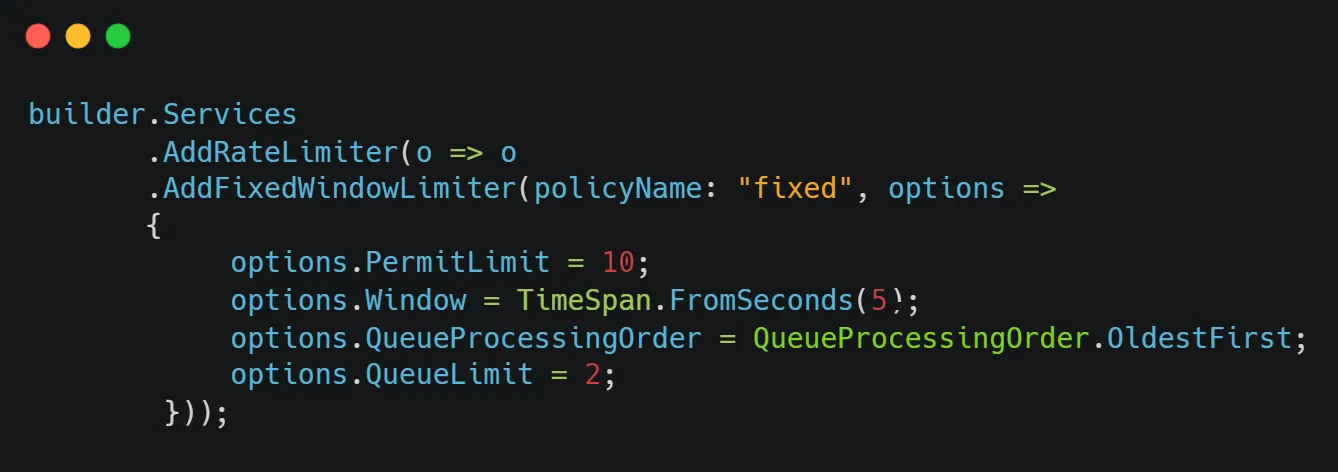 - AddFixedWindowLimiter - the method uses a fixed time window to limit requests. When the time window expires, a new time window starts and the request limit is reset.
- PermitLimit - A maximum of 10 requests
- Window - per 5 seconds window.
- QueueProcessingOrder - behaviour when not enough resources can be leased (Process oldest requests first).
- QueueLimit - Maximum cumulative permit count of queued acquisition requests.
- AddFixedWindowLimiter - the method uses a fixed time window to limit requests. When the time window expires, a new time window starts and the request limit is reset.
- PermitLimit - A maximum of 10 requests
- Window - per 5 seconds window.
- QueueProcessingOrder - behaviour when not enough resources can be leased (Process oldest requests first).
- QueueLimit - Maximum cumulative permit count of queued acquisition requests.
Enable using RateLimiter middleware
After adding a service to the collection of services, it is necessary to enable its use:

Use it
Finally, you can use a rate limiting.
For Minimal API, just call a method RequireRateLimiting on defined API route. Argument "fixed" is a policyName of created RateLimiting service (in our case it is Fixed Window).
For the Controllers, you need also to tell the middleware to require rate limiting:

Or for each contoller and/or actions you can to specify an attribute:
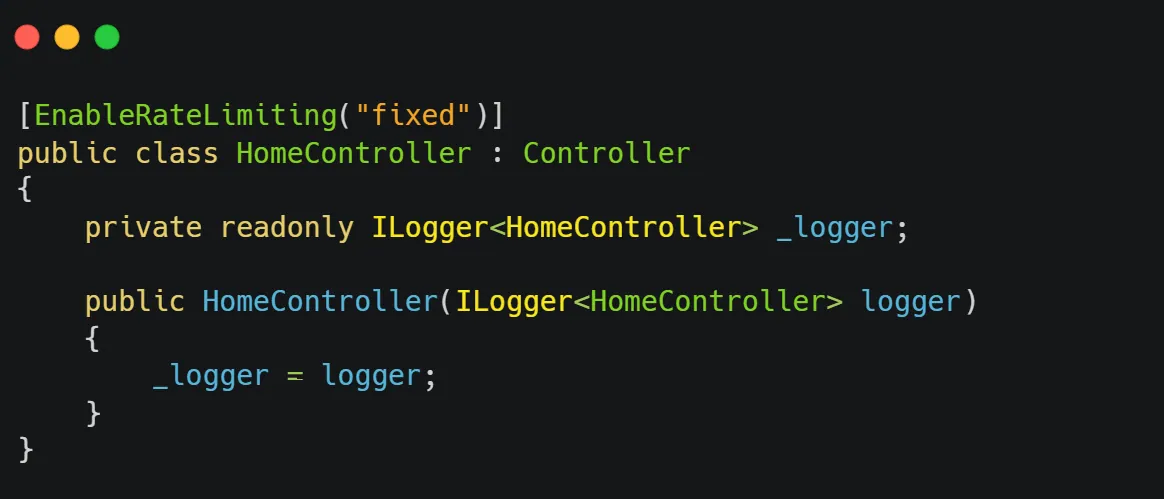 Note: Do not use "magic strings", instead put "fixed" and other values in the configuration file.
How to test?
Load testing with JMeter from Apache. That's all from me for today. Make a coffee and try it on your projects.
dream BIG!
For API security, also consider API Key Authentication and using CORS properly.